
The Madaxeman
Madaxeman.com's Home Page
  • Home
  • Latest Posts
  • Links Page
  • Battle Reports
  • ADLG Index
  • ADLG Wiki
  • Malifaux
  • C London Club
  • 15mm Gallery
  • 15mm Suppliers
  • Facebook
  • The Podcast
  • 10mm
  • Consent Preferences
 RSS Feed

Madaxemans 10mm & Real World Photo Gallery

Photos from museums, and from my 10mm wargaming collection

  • Home
  • Login
  • Album list
    • Last uploads
    • Last comments
    • Most viewed
    • Top rated
    • By date
    • My Favorites
  • Search

The 10mm & Real World Museums Photo Directory - helping you choose the best 10mm tanks, or dig out real cammo schemes from tanks and other military vehicles in museums and shows around the world. You can also search the directory by manufacturer, army or keyword

Anyone can rate the photos just by clicking on the stars beneath each photo. Ratings use a scale of 0-5 where 5 = excellent and 0 = terrible.

Home > Museums and Shows > Bovington

Most viewed - Bovington
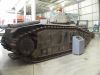
PICT1741.JPG
Char B322 viewstarting in the early twenties, its development and production were repeatedly delayed, resulting in a vehicle that was both technologically complex and expensive, and already obsolescent when real mass-production of a derived version, the Char B1 "bis", started in the late thirties. Although a second uparmoured version, the Char B1 "ter", was developed, only two prototypes were built.
IMGP0555.JPG
Su76321 viewsThe SU-76 (Samokhodnaya Ustanovka 76) was a Soviet self-propelled gun used during and after World War II. The SU-76 was based on a lengthened and widened version of the T-70 tank chassis. Its simple construction made it the second most produced Soviet armoured vehicle of World War II, after the T-34 tank.
Crews loved this vehicle for its simplicity, reliability, and ease of use. Because of this and the steering which was regarded as cumbersome the vehicle was (un)affectionately called suka ("bitch"), Suchka ("little bitch") by its crews
IMGP0560.JPG
M5 A1 Stuart321 viewsThe M3 Stuart, formally Light Tank M3, was an American light tank of World War II. It was supplied to British and Commonwealth forces under lend-lease prior to the entry of the U.S. into the war. Thereafter, it was used by U.S. and Allied forces until the end of the war.
PICT1716.JPG
Crossley Armoured Car 321 viewsIn 1923 Crossley supplied a number of chassis to Vickers at Crayford to be fitted with armoured car superstructure. Completed vehicles were sold to India (approx 100), Britain, South Africa, Canada, Argentina (six supplied in 1927) and Japan (12 supplied in 1925).
PICT1739.JPG
Char B 320 viewsThe Char B1 was a French heavy tank manufactured before World War II.
The Char B1 was a specialised heavy break-through vehicle, originally conceived as a self-propelled gun with a 75 mm howitzer in the hull; later a 47 mm gun in a turret was added, to allow it to function also as a Char de Bataille, a "battle tank" fighting enemy armour, equipping the armoured divisions of the Infantry Arm
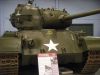
IMGP0581.JPG
M26 Peshing319 viewsThe Pershing was the first operational heavy tank of the US Army; originally designated the T26, the tank ended its service as the M26 Pershing medium tank. Named after General John J. Pershing who led the American Expeditionary Force in Europe in World War I, it was briefly used both in World War II and in the Korean War. Intended as an improvement of the M4 Sherman, the prolonged time of development meant only a small number saw combat in the European theater, most notably the 9th Armored Division's dramatic dash to take the Bridge at Remagen.
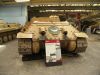
PICT1842.JPG
SU 100319 viewsThe SU-100 was a Soviet casemate-style tank destroyer. It was used extensively during the last year of World War II and saw service for many years afterwards with the armies of Soviet allies around the world.
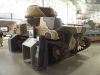
PICT1768.JPG
Lee/Grant318 viewsThe design was unusual because the main weapon — a larger caliber, low-velocity 75 mm gun — was in an offset sponson mounted in the hull with limited traverse. A small turret with a lighter, high-velocity 37 mm gun sat on the tall hull. A small cupola on top of the turret held a machine gun. The use of two main guns was seen on the French Char B, the Soviet T-35, and the Mark I version of the British Churchill tank. In each case, two weapons were mounted to give the tanks adequate capability in firing both anti-personnel high explosive ammunition and armor-piercing ammunition for anti-tank combat
PICT1780.JPG
Panther318 viewsThe Panther tank was a compromise of various requirements. While having essentially the same engine as the Tiger I tank, it had better frontal armor (including the benefit of a sloped armor, increasing effective armor depth), better gun penetration, was lighter and thus faster, and could traverse rough terrain better than the Tigers. The tradeoff was weaker side armor.
IMGP0586.JPG
M10 Tank Destroyer317 viewsIn its combat debut in Tunisia in 1943 during the North African campaign, the M10 was successful as its M7 3-inch gun could destroy most German tanks then in service. The M10's heavy chassis did not conform to the tank destroyer doctrine of employing very light high-speed vehicles, and starting in mid-1944 it began to be supplemented by the 76mm Gun Motor Carriage M18 "Hellcat". Later in the Battle of Normandy, the M10's gun proved to be ineffective against the frontal armor of the newer German Tiger and Panther tanks unless firing HVAP rounds
270 files on 27 page(s) 1 - 5 6 7 8 9 10 11 12 13 14 - 27


Visit Madaxeman on

Youtube Logo
Blogger Logo
Facebook Logo
Podbean Logo
Twitter Logo
Spotify Logo
Pinterest Logo
iTunes Logo
Tune In Logo

Podcasts to download from Madaxeman.com

(Also available on Podbean, iTunes and Spotify)


(These are "affiliate links". If you buy something after clicking on them I get a small kickback from eBay)

Page Loads for the 10mm & Museums Gallery:

About This Site & Privacy Information

Powered by Coppermine Photo Gallery