
The Madaxeman
Madaxeman.com's Home Page
  • Home
  • Latest Posts
  • Links Page
  • Battle Reports
  • ADLG Index
  • ADLG Wiki
  • Malifaux
  • C London Club
  • 15mm Gallery
  • 15mm Suppliers
  • Facebook
  • The Podcast
  • 10mm
  • Consent Preferences
 RSS Feed

Madaxemans 10mm & Real World Photo Gallery

Photos from museums, and from my 10mm wargaming collection

  • Home
  • Login
  • Album list
    • Last uploads
    • Last comments
    • Most viewed
    • Top rated
    • By date
    • My Favorites
  • Search

The 10mm & Real World Museums Photo Directory - helping you choose the best 10mm tanks, or dig out real cammo schemes from tanks and other military vehicles in museums and shows around the world. You can also search the directory by manufacturer, army or keyword

Anyone can rate the photos just by clicking on the stars beneath each photo. Ratings use a scale of 0-5 where 5 = excellent and 0 = terrible.

Home > Museums and Shows > Bovington

Most viewed - Bovington
IMGP0576.JPG
RAM Kangaroo303 viewsA Kangaroo was a World War II Commonwealth or British armoured personnel carrier (APC), created by conversion of a tank chassis. Created as an expedient measure by the Canadian Army, the Kangaroos were so successful that they were soon being used by British forces as well. Their ability to manoeuvre in the field with the tanks was a major advantage over earlier designs, and led to the dedicated APC designs that were introduced by almost all armies immediately after the war.
PICT1710.JPG
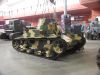
Medium Mark A Whippet303 viewsThe Medium Mark A Whippet was a British tank of World War I. It was intended to complement the slower British heavy tanks by using its relative mobility and speed in exploiting any break in the enemy lines. Possibly the most successful British tank of World War I, the Whippet was responsible for more German casualties than any other British tank of the war. Whippets later took part in several of the British Army's postwar actions, notably in Ireland and North Russia.
PICT1720.JPG
Lanchester Armoured Car303 viewsBy 1939, most Lanchesters (13 Mk I, 1 Mk IA, 5 Mk II, 3 Mk IIA) were sent to the Far East and assigned to the Selangor and Perak battalions of Federated Malay States Volunteer Force, the Singapore Volunteer Corps, Straits Settlements Volunteer Force and the 2nd battalion of Argyll & Sutherland Highlanders in Malaya. Some of these took part in the Malayan Campaign (December 1941 - 15 February 1942) against Japan.
PICT1839.JPG
Charioteer302 viewsIn practice the Charioteer was used by British Territorial Army units only and during mid and late 1950s most of the vehicles were sold to Austria, Finland, Jordan and Lebanon.
IMGP0587.JPG
Hetzer301 viewsThe Jagdpanzer 38(t) (Sd.Kfz. 138/2), later known as Hetzer ("baiter"), was a German light tank destroyer of the Second World War based on a modified Czechoslovakian Panzer 38(t) chassis. The project was inspired by the Romanian "Mareşal" tank destroyer.
IMGP0597.JPG
A9 Tank301 viewsThe A9 weighed 12 tons, was 5.8 metres long, 2.65 metres high, 2.5 metres wide, and had a top speed of 25 mph on road and 15 mph off. Its maximum road range was 150 miles. The ammunition load was 100 2-pounder rounds and a total of 3,000 rounds for the three Vickers machine guns.
IMGP0623.JPG
WW1 British tanks301 views
PICT1706.JPG
Centurion301 viewsThe Centurion, introduced in 1945, was the primary British main battle tank of the post-World War II period. It was a successful tank design, with upgrades, for many decades. The chassis was also adapted for several other roles.
Development of the tank began in 1943 and manufacture of the Centurion began in January 1945, six prototypes arriving in Belgium less than a month after the war in Europe ended in May 1945.
PICT1726.JPG
Vickers Mk E Tank301 viewsThe Vickers 6-Ton Tank or Vickers Mark E was a British light tank designed as a private project at Vickers. It was not purchased by the British Army, but was picked up by a large number of foreign armed forces and was copied almost exactly by the Soviets as the T-26. It was also the direct predecessor of the Polish 7TP tank. By the start of World War II it was the second most common tank design in the world after the Renault FT.
PICT1738.JPG
Pz II301 viewsThe Panzer II was designed before the experience of the Spanish Civil War of 1936-39 showed that shell-proof armor was required for tanks to survive on a modern battlefield. Prior to that, armor was designed to stop machinegun fire and High Explosive shell fragments.
270 files on 27 page(s) 1 - 10 11 12 13 14 15 16 17 18 19 - 27


Visit Madaxeman on

Youtube Logo
Blogger Logo
Facebook Logo
Podbean Logo
Twitter Logo
Spotify Logo
Pinterest Logo
iTunes Logo
Tune In Logo

Podcasts to download from Madaxeman.com

(Also available on Podbean, iTunes and Spotify)


(These are "affiliate links". If you buy something after clicking on them I get a small kickback from eBay)

Page Loads for the 10mm & Museums Gallery:

About This Site & Privacy Information

Powered by Coppermine Photo Gallery