
The Madaxeman
Madaxeman.com's Home Page
  • Home
  • Latest Posts
  • Links Page
  • Battle Reports
  • ADLG Index
  • ADLG Wiki
  • Malifaux
  • C London Club
  • 15mm Gallery
  • 15mm Suppliers
  • Facebook
  • The Podcast
  • 10mm
  • Consent Preferences
 RSS Feed

Madaxemans 10mm & Real World Photo Gallery

Photos from museums, and from my 10mm wargaming collection

  • Home
  • Login
  • Album list
    • Last uploads
    • Last comments
    • Most viewed
    • Top rated
    • By date
    • My Favorites
  • Search

The 10mm & Real World Museums Photo Directory - helping you choose the best 10mm tanks, or dig out real cammo schemes from tanks and other military vehicles in museums and shows around the world. You can also search the directory by manufacturer, army or keyword

Anyone can rate the photos just by clicking on the stars beneath each photo. Ratings use a scale of 0-5 where 5 = excellent and 0 = terrible.

Home > Museums and Shows > Bovington

Most viewed - Bovington
IMGP0549.JPG
Locust in a Hamilcar Glider frame351 viewsThe Light Tank (Airborne) M22 or Locust was an American-designed airmobile light tank which was produced during World War II. The Locust began development in 1941 after the British War Office requested that the American government design a purpose-built airborne light tank which could be transported by glider into battle to support British airborne forces.
PICT1792.JPG
Cromwell351 viewsThe Cromwell and the related Centaur were the product of further development of British cruiser tanks, and they were designed as the replacement for the Crusader tank, which although not yet in service would become obsolete in time. In late 1940, the General Staff set out the specifications for the new tank, and designs were submitted in early 1941. The tank would be fitted with the QF 6 pounder gun with the expectation that it would enter service in 1942.
PICT1759.JPG
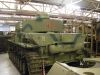
The Tiger I344 viewsProduction of the Tiger I began in August 1942, and 1,355 were built by August 1944 when production ceased. Production started at a rate of 25 per month and peaked in April 1944 at 104 per month. Strength peaked at 671 on 1 July 1944
IMGP0574.JPG
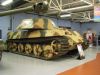
King Tiger "Porsche" Turret343 viewsUnlike in this one, the more common "production" turret, sometimes called the "Henschel" turret, was simplified with a significantly thicker flat face, no shot trap (created by the curved face of the initial-type turret), and less-steeply sloped sides, which prevented the need for a bulge for the commander's cupola
IMGP0583.JPG
Tiger II343 views
IMGP0548.JPG
Pz IV342 viewsThe Panzer IV was the most widely exported tank in German service, with around 300 sold to partners such as, Finland, Romania, Spain and Bulgaria.
IMGP0554.JPG
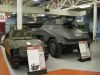
SdKfz 304 and 234/3 340 viewsThe SdKfz 234 (Sonderkraftfahrzeug 234, or special purpose vehicle 234) was an eight-wheeled armoured car used by the German Army in the Second World War. It broadly resembles the SdKfz 231 (8 rad) The 234/3 features 1 x 7.5 cm K51 L/24 in open-topped superstructure replacing the turret. 88 built between June and December, 1944.
PICT1849.JPG
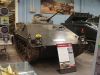
Schützenpanzer SPz 11-2 Kurz340 viewsThe Schützenpanzer SPz 11-2 Kurz armored reconnaissance vehicle was developed for the West German army and was a minor modification of a French designed vehicle (Hotchkiss SP1A). During the period between 1958 to 1962, the West German army received some 2,374 of these light armoured vehicles with the SPz 11-2 Kurz being developed as the reconnaissance version.
IMGP0609.JPG
King Tiger337 viewsLike the Tiger I, each tank was issued with two sets of tracks: a normal "battle track" and a narrower "transport" version used during rail movement. The transport tracks reduced the overall width of the load and could be used to drive the tank short distances on firm ground. The crew were expected to change to normal battle tracks as soon as the tank was unloaded
IMGP0585.JPG
Jagdpanther335 viewsThe Jagdpanther had a good power-to-weight ratio and a powerful main gun, which enabled it to destroy any type of Allied tank. Based on the existing Panther Ausf G chassis, the vehicle did not suffer too many mechanical problems. It had an upgraded transmission (the Zf Ak 7-400 heavy duty) - which had been planned for the Panther II - and final drive to counter the Panther's main weakness. It was manned by a crew of six: a driver, radio-operator, commander, gunner and two loaders
270 files on 27 page(s) 1 2 3 4 5 6 7 8 9 10 11 - 27


Visit Madaxeman on

Youtube Logo
Blogger Logo
Facebook Logo
Podbean Logo
Twitter Logo
Spotify Logo
Pinterest Logo
iTunes Logo
Tune In Logo

Podcasts to download from Madaxeman.com

(Also available on Podbean, iTunes and Spotify)


(These are "affiliate links". If you buy something after clicking on them I get a small kickback from eBay)

Page Loads for the 10mm & Museums Gallery:

About This Site & Privacy Information

Powered by Coppermine Photo Gallery