
The Madaxeman
Madaxeman.com's Home Page
  • Home
  • Latest Posts
  • Links Page
  • Battle Reports
  • ADLG Index
  • ADLG Wiki
  • Malifaux
  • C London Club
  • 15mm Gallery
  • 15mm Suppliers
  • Facebook
  • The Podcast
  • 10mm
  • Consent Preferences
 RSS Feed

Madaxemans 10mm & Real World Photo Gallery

Photos from museums, and from my 10mm wargaming collection

  • Home
  • Login
  • Album list
    • Last uploads
    • Last comments
    • Most viewed
    • Top rated
    • By date
    • My Favorites
  • Search

The 10mm & Real World Museums Photo Directory - helping you choose the best 10mm tanks, or dig out real cammo schemes from tanks and other military vehicles in museums and shows around the world. You can also search the directory by manufacturer, army or keyword

Anyone can rate the photos just by clicking on the stars beneath each photo. Ratings use a scale of 0-5 where 5 = excellent and 0 = terrible.

Most viewed
IMGP7960_(Large).JPG
Images from Fort Copacabana, Rio307 viewsFort Copacabana, Rio contains the Museum of the History of the Brazilian Army and a coastal defense fort, Fort Copacabana
IMGP7964_(Large).JPG
Images from Fort Copacabana, Rio307 viewsFort Copacabana, Rio contains the Museum of the History of the Brazilian Army and a coastal defense fort, Fort Copacabana
IMGP7963_(Large).JPG
Images from Fort Copacabana, Rio307 viewsFort Copacabana, Rio contains the Museum of the History of the Brazilian Army and a coastal defense fort, Fort Copacabana
IMGP0099.JPG
Boxter307 viewsPhotos of AFVs at the IDEX 2013 exhibition Boxer on Army Technology.com
IMGP0589.JPG
Matilda I307 viewsThe Tank, Infantry, Mk I, Matilda I (A11)[1] was a British infantry tank of the Second World War. It is not to be confused with the later model Tank, Infantry Mk II (A12), also known as the "Matilda II" which took over the "Matilda" name after the early part of the war when the first Matilda was withdrawn from combat service. They were of totally different design and did not share components, but did have some similar traits because they were both designed to be infantry tanks, a type of tank that tended to sacrifice speed for increased armour protection.
IMGP0588.JPG
Pz I Command tank307 viewsBetween 1934 and the mid-1940s several variants of the Panzer I were designed, especially during the later years of its combat history. Because they were obsolescent from their introduction, incapable of defeating foreign armor, and outclassed by newer German tanks, the Panzer I chassis were increasingly repurposed as tank destroyers and other variants. One of the most well known variants was the kleiner Panzerbefehlswagen ("small armored command vehicle"), built on the Ausf. A and Ausf. B chassis
PICT1707.JPG
Little Willie307 viewsLittle Willie was a prototype in the development of the British Mark I tank. Constructed in the autumn of 1915 at the behest of the Landships Committee, it was the first completed tank prototype in history. Little Willie is the oldest surviving individual tank, preserved as one of the most famous pieces in the collection of the British Bovington Tank Museum.
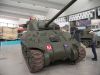
PICT1794.JPG
Sherman307 viewsThe armor of the M4 was effective against most early war anti-tank weapons, but was easily penetrated by later German tank guns and anti-tank guns. Early versions had unfortunate shot traps, locations where the effect of slope was greatly reduced, located just in front of the driver and assistant driver.
PICT1822.JPG
Scorpion307 viewsAlvis built more than 3,000 Scorpion vehicles for the British Army and Royal Air Force Regiment and the export market. All the CVR(T) vehicles were to be air-portable and two Scorpions could be carried in a C130 Hercules. Another requirement of the CVR(T) project was the low ground pressure - similar to that of a soldier on foot - and this would serve it well in the boggy conditions of the Falklands War.
PICT1843.JPG
BMP 2307 viewsThe BMP-2 is broadly similar to the BMP-1. The most significant changes are:
A new two-man turret armed with the 2A42 30 mm autocannon and the 9P135M ATGM launcher capable of firing SACLOS guided 9M111 "Fagot" (AT-4 Spigot), 9M113 "Konkurs" (AT-5 Spandrel) and 9M113M "Konkurs-M" (AT-5B Spandrel B) anti-tank missiles.
The commander now sits with the gunner in an enlarged turret.
Seven troops are carried instead of eight.
Two rear infantry roof hatches instead of three.
Slightly improved armour.
3464 files on 347 page(s) 1 - 163 164 165 166 167 168 169 170 171 172 - 347


Visit Madaxeman on

Youtube Logo
Blogger Logo
Facebook Logo
Podbean Logo
Twitter Logo
Spotify Logo
Pinterest Logo
iTunes Logo
Tune In Logo

Podcasts to download from Madaxeman.com

(Also available on Podbean, iTunes and Spotify)


(These are "affiliate links". If you buy something after clicking on them I get a small kickback from eBay)

Page Loads for the 10mm & Museums Gallery:

About This Site & Privacy Information

Powered by Coppermine Photo Gallery