
The Madaxeman
Madaxeman.com's Home Page
  • Home
  • Latest Posts
  • Links Page
  • Battle Reports
  • ADLG Index
  • ADLG Wiki
  • Malifaux
  • C London Club
  • 15mm Gallery
  • 15mm Suppliers
  • Facebook
  • The Podcast
  • 10mm
  • Consent Preferences
 RSS Feed

Madaxemans 10mm & Real World Photo Gallery

Photos from museums, and from my 10mm wargaming collection

  • Home
  • Login
  • Album list
    • Last uploads
    • Last comments
    • Most viewed
    • Top rated
    • By date
    • My Favorites
  • Search

The 10mm & Real World Museums Photo Directory - helping you choose the best 10mm tanks, or dig out real cammo schemes from tanks and other military vehicles in museums and shows around the world. You can also search the directory by manufacturer, army or keyword

Anyone can rate the photos just by clicking on the stars beneath each photo. Ratings use a scale of 0-5 where 5 = excellent and 0 = terrible.

Home > Museums and Shows

Most viewed - Museums and Shows
PICT1728.JPG
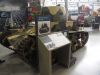
Vickers Mk E Tank165 viewsThe British Army evaluated the Mark E, but rejected it, apparently due to questions about the reliability of the suspension. Vickers then started advertising the design to all buyers, and soon received a trickle of orders eventually including USSR, Greece, Poland, Bolivia, Siam, Finland, Portugal, China and Bulgaria. A Thai order was placed, but taken over by the British when the war started. Vickers built a total of 153 (the most common figure) Mark E's.
PICT1730.JPG
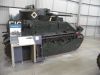
Medium Tank Mk II165 viewsThe Vickers Medium Mark II and its predecessor the Vickers Medium Mark I replaced some of the Mark V heavy tanks. Both tanks equipped the Royal Tank Regiments until they were phased out starting in 1938. In November 1939, some Medium Mark IIs were sent to Egypt for experiments being conducted by Major-General Sir Percy Hobart and his Mobile Division (Egypt), but the Vickers Mediums in Egypt were also phased out before Italy declared war in June 1940. The Mediums were used for initial instruction in driver training.
PICT1736.JPG
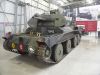
Mk IV A13 Mk II165 viewsThe A13 MkII, Cruiser Tank Mk IV, had a maximum armour thickness of 30 mm, and faceted armour was mounted on the original turret's sides and rear. This gave the tank a far more modern appearance. Some Mk III tanks were re-built to Mk IV standard while at the factory.
PICT1733.JPG
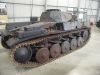
Pz II165 viewsThe Panzer II is the common name used for a family of German tanks used in World War II. The official German designation was Panzerkampfwagen II (abbreviated PzKpfw II).
Although the vehicle had originally been designed as a stopgap while larger, more advanced tanks were developed, it nonetheless went on to play an important role in the early years of World War II, during the Polish and French campaigns. The Panzer II was the most numerous tank in the German Panzer divisions beginning with the invasion of France. It was used in both North Africa against the British and on the Eastern Front against the Soviet Union.
PICT1752.JPG
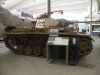
Pz III165 viewsThe Panzer III was intended as the primary battle tank of the German forces. However, when it initially met the KV and T-34 tanks it proved to be inferior in both armor and gun power. To meet the growing need to counter these tanks, the Panzer III was up-gunned with a longer, more powerful 50-millimetre (1.97 in) cannon and received more armour although this failed to effectively address the problem caused by the KV tank designs.
PICT1767.JPG
Lee/Grant165 viewsThe M3 was well armed and armored for the period, but due to design flaws (high silhouette, archaic sponson mounting of the main gun, below-average off-road performance) it was not satisfactory and was withdrawn from front line duty as soon as the M4 Sherman became available in large numbers.
PICT1795.JPG
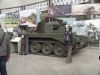
Cromwell165 viewsThe Cromwell first saw action in the Battle of Normandy in June 1944. The tank equipped the armoured reconnaissance regiments, of the Royal Armoured Corps, within the 7th, 11th, and Guards Armoured Divisions. While the armoured regiments of the latter two divisions were equipped with M4 Shermans, the armoured regiments of the 7th Armoured Division were fully equipped with Cromwell tanks.
PICT1794.JPG
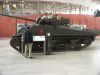
Sherman165 viewsThe armor of the M4 was effective against most early war anti-tank weapons, but was easily penetrated by later German tank guns and anti-tank guns. Early versions had unfortunate shot traps, locations where the effect of slope was greatly reduced, located just in front of the driver and assistant driver.
PICT1800.JPG
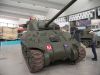
Sherman165 viewsThe M4A1 Sherman first saw combat at the Second Battle of El Alamein in October 1942 with the British 8th Army. The first U.S. Shermans in battle were M4A1s in Operation Torch the next month. At this time, Shermans successfully engaged German Panzer IIIs with long barreled 50 mm L/60 guns, and Panzer IVs with short barreled 75 mm L/24 guns
PICT1799.JPG
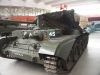
Cromwell165 viewsTotal A27 production consisted of 4,016 tanks; 950 of which were Centaurs and 3,066 Cromwells. In addition, 375 Centaur hulls were built to be fitted with an anti-aircraft gun turret; only 95 of these were completed.
2197 files on 220 page(s) 1 - 121 122 123 124 125 126 127 128 129 130 - 220


Visit Madaxeman on

Youtube Logo
Blogger Logo
Facebook Logo
Podbean Logo
Twitter Logo
Spotify Logo
Pinterest Logo
iTunes Logo
Tune In Logo

Podcasts to download from Madaxeman.com

(Also available on Podbean, iTunes and Spotify)


(These are "affiliate links". If you buy something after clicking on them I get a small kickback from eBay)

Page Loads for the 10mm & Museums Gallery:

About This Site & Privacy Information

Powered by Coppermine Photo Gallery