
The Madaxeman
Madaxeman.com's Home Page
  • Home
  • Latest Posts
  • Links Page
  • Battle Reports
  • ADLG Index
  • ADLG Wiki
  • Malifaux
  • C London Club
  • 15mm Gallery
  • 15mm Suppliers
  • Facebook
  • The Podcast
  • 10mm
  • Consent Preferences
 RSS Feed

Madaxemans 10mm & Real World Photo Gallery

Photos from museums, and from my 10mm wargaming collection

  • Home
  • Login
  • Album list
    • Last uploads
    • Last comments
    • Most viewed
    • Top rated
    • By date
    • My Favorites
  • Search

The 10mm & Real World Museums Photo Directory - helping you choose the best 10mm tanks, or dig out real cammo schemes from tanks and other military vehicles in museums and shows around the world. You can also search the directory by manufacturer, army or keyword

Anyone can rate the photos just by clicking on the stars beneath each photo. Ratings use a scale of 0-5 where 5 = excellent and 0 = terrible.

Home > Museums and Shows

Most viewed - Museums and Shows
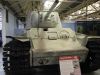
IMGP0567.JPG
KV 1184 viewshe KV's strengths included armor that was impenetrable by any tank-mounted weapon then in service except at point-blank range, that it had good firepower, and that it had good traction on soft ground. It also had serious flaws: it was difficult to steer, the transmission (which was a twenty year old Caterpillar design) was unreliable (and was known to have to be shifted with a hammer), and the ergonomics were poor, with limited visibility and no turret basket
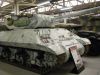
IMGP0580.JPG
M10 Tank Destroyer184 viewsThe M10 tank destroyer, formally 3-inch Gun Motor Carriage, M10 was a United States tank destroyer of World War II based on the chassis of the M4 Sherman tank. It was numerically the most important U.S. tank destroyer of World War II and combined a reasonably potent anti-tank weapon with a turreted platform (unlike the previous M3 GMC, whose gun was capable of only limited traverse). Despite the introduction of more-powerful types as replacements, it remained in service until the end of the war. Some of those replacements were in fact modified and/or rebuilt from the M10 itself.
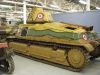
IMGP0599.JPG
S35 Somua184 viewsAfter the June 1940 armistice, S 35s were allowed to be sent to West Africa to bolster the hold of the Vichy regime on that region. They were issued to the 12e régiment de Chasseurs d'Afrique that, after French forces in Africa had sided with the Allies, operated them against German and Italian forces during the Tunisia Campaign. After taking part in the Tunis victory parade, 12e RCA's S35s were replaced by M4 Shermans, but crews often affixed the SOMUA plate on their new tanks.
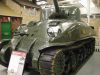
IMGP0602.JPG
Sherman184 viewsProduction of the Sherman was favored by the commander of the Armored Ground Forces, albeit controversially, over the heavier M26 Pershing, which resulted in the latter being deployed too late to play any significant role in the war. In the Pacific Theater, the Sherman was used chiefly against Japanese infantry and fortifications; in its rare encounters with much lighter Japanese tanks with weaker armor and guns, the Sherman's superiority was overwhelming. Almost 50,000 vehicles were produced, and its chassis also served as the basis for numerous other armored vehicles such as tank destroyers, tank retrievers, and self-propelled artillery.
IMGP0607.JPG
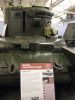
Matilda II CDL184 viewsMatilda II CDL / Matilda V CDL (Canal Defence Light)
The normal turret was replaced by a cylindrical one containing a searchlight (projected through a vertical slit) and a BESA machine gun.
IMGP0628.JPG
WW1 British tanks184 views
PICT1746.JPG
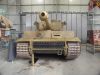
The Tiger I184 viewsThe Tiger tank was too heavy for small bridges, so it was designed to ford four-metre deep water. This required unusual mechanisms for ventilation and cooling when underwater. At least 30 minutes of set-up time was required, with the turret and gun being locked in the forward position, and a large snorkel tube raised at the rear. The two rear compartments (each containing a fuel tank, radiator and fans) were floodable. Only the first 495 units were fitted with this deep fording system; all later models were
PICT1837.JPG
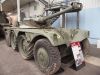
Panhard EBR184 viewsThe Panhard EBR (Panhard Engin Blindé de Reconnaissance, French: Armored Reconnaissance Vehicle) is an armoured car designed by Panhard for the French Army and later used across the globe, notably by the French Army during the Algerian War and the Portuguese Army during the Portuguese Colonial War in Angola, Mozambique and Guinea-Bissau.
IMGP5025.JPG
T72 training model 184 viewsT72 training model - very rare
IMGP5030.JPG
Malkara Hornet missile184 viewsThe Malkara missile (from an Aboriginal word for "shield") was one of the earliest guided anti-tank missiles (ATGMs). It was jointly developed by Australia and the United Kingdom between 1951 and 1954, and was in service from 1958 until gradually replaced by the Vickers Vigilant missile in the late 1960s. It was intended to be light enough to deploy with airborne forces, yet powerful enough to knock out any tank then in service.
2197 files on 220 page(s) 1 - 82 83 84 85 86 87 88 89 90 91 - 220


Visit Madaxeman on

Youtube Logo
Blogger Logo
Facebook Logo
Podbean Logo
Twitter Logo
Spotify Logo
Pinterest Logo
iTunes Logo
Tune In Logo

Podcasts to download from Madaxeman.com

(Also available on Podbean, iTunes and Spotify)


(These are "affiliate links". If you buy something after clicking on them I get a small kickback from eBay)

Page Loads for the 10mm & Museums Gallery:

About This Site & Privacy Information

Powered by Coppermine Photo Gallery